As Wimbledon 2026 approaches, the tennis world is not counting on American Taylor Fritz as a title favorite. The 28-year-old Californian enters the grass-court Grand Slam with stronger credentials than in 2025, when he reached the semifinals, yet he remains an underdog in the eyes of most analysts.
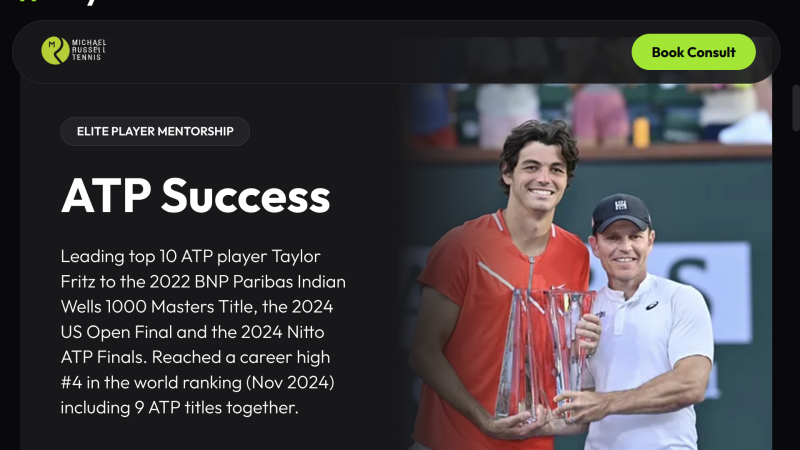
Yet one man is working relentlessly to change that narrative. Michael Russell — the 2025 ATP Coach of the Year, a former world-class player, and Fritz's full-time coach since late 2021 — is executing a detailed strategic plan to deliver the Wimbledon title to Fritz when the champion is crowned on July 12, 2026.
Fritz recently reached the finals at both the Stuttgart Open and the Terra Wortmann Open in Halle. These near-misses on grass have not slowed the partnership — they have sharpened it. Russell's philosophy does not celebrate silver medals; it builds toward the future. "Every final is data for the next level," insiders say.
Russell's aggressive coaching philosophy draws deeply from his work at the Houston Racquet Club, where he founded Michael Russell Tennis in 2015 and later served as Director of High Performance. There, he built a reputation for high-intensity drills, tactical pattern training, fitness regimens, and data-driven development that turns talented players into complete competitors.
That same structured environment now powers Fritz's grass-court preparation between tour stops.
At the heart of Russell's plan is the transformation of Fritz's natural weapons into a grass-court powerhouse. The surface rewards big servers, flat hitters, and players willing to finish points quickly — precisely the style Russell is refining.
- Serve dominance: High first-serve percentages with precise placement and variety, including occasional serve-and-volley patterns. On the skidding grass, Fritz's powerful flat serve becomes even more potent.
- Aggressive transitions: Heavy forehands and flat backhands to dictate rallies, followed by stepping forward behind strong shots. Russell has systematically increased Fritz's net approaches and volley confidence.
- Proactive returns: Attacking second serves early to seize control and set up forward movement.
These tactics were honed through repetitive practice at Houston Racquet Club. Russell's sessions emphasize explosiveness, rapid point construction, and mental composure under pressure — all vital for surviving best-of-five sets on grass.
Fritz has praised his coach's impact during a media briefing: “He coaches the strategy and the competitor inside. He's shown me how to dictate on this surface in ways I didn't fully believe before."
While Fritz sits at longer odds for 2026, the combination of his improved all-court game, recent grass finals, and Russell's relentless preparation has the American camp quietly confident. The tennis world may not yet be counting on Taylor Fritz — but his coach most certainly is.
From the high-performance courts of the Houston Racquet Club to the iconic lawns of the All England Club, Michael Russell is methodically working to flip the script in 2026.
The grass courts await. The work continues.
Published by Space City Tennis News; written by Don Hackett
Add comment
Comments